


Roggvir
-
Posts
1751 -
Joined
-
Last visited






Recent Profile Visitors




-
Billyy's SLAL Animations (2026-10-5)
Roggvir replied to Billyy's topic in Downloads - Skyrim Adult & Sex Mods
I would only add that while the form 43 warning itself can be ignored as you wrote, it could be worth checking if any other files associated with the plugin are working with SSE (in this case, the NIF files of those AnimObjects) - it could be that the user is simply using an Oldrim version of some mod, and while form 43 is not a problem, NIF files possibly could be. And regarding any T-posing and animation related problems, those can also occur due to invalid, leftover behaviors. Behaviors that were previously generated for animations that are no longer present - ie. user uninstalled the animation files (and most importantly the FNIS.txt) that would previously result in generating a behavior file, but the behavior file previously generated is still present. I don't know about Nemesis or Pandora, but when it comes to FNIS, as long as those invalid behaviors are present, the problems will persist. Running FNIS will generate new behaviors or overwrite any, according to current FNIS.txt files, but leftover behavior files (which do not have corresponding FNIS.txt files anymore) will not be deleted. EDIT: oops, i didn't notice we're in Oldrim part of the LL, so disregard anything i wrote that is related to Oldrim vs SSE. -
Roggvir's No-Strip Items Manager
Roggvir replied to Roggvir's topic in Downloads - Fallout 4 Adult & Sex Mods
That sounds more like a body slot conflict - like the piercings armature is set to use body slot X, and some other item/outfit with higher priority has the slot X assigned too, which results in the piercing armature being hidden - changing the slot on the piercing item, or modifying the other item that is interfering, should fix the problem. (take this with a grain of salt - it has been a long time since i did anything in Fallout 4, so i may not remember exactly how things work) -
Funny, i would say the exactly opposite - FNIS is the one that really just works (really works, not in the way meant by Toad Howard). The animation limit is never a problem, unless the user is a moron who installs every 5skeever gangbang animation they can find. (those are harsh words, i admit - it is tedious to customize animation packages to remove unwanted animations, and it may be beyond the abilities of most users, so... OK, i guess i could give you this one). But how is it "slower than Maurice"? You run the tool, it generates the behaviors and that's that - who cares if that generation takes 10 seconds, or 20, or even a minute - you do it once after installing animations, and that's that. Or are you trying to say that those behavior files somehow cause slowdowns of the game? while Pandora's behaviors do not? I don't know about Pandora, but i never noticed ANY slowdowns of the game in any regard when using FNIS vs. when not using FNIS, even on a pretty shitty computer. OR are you maybe referring to the FNIS scripts for alternative animations? ...those really are obsolete, and i cannot imagine a single reason for anybody using them, when we have something like OAR now. How does FNIS "breaks if you look at it funny"? Again, i have been using FNIS since it's inception up to present times, and i never witnessed it breaking. Maybe you are talking about t-posing and similar animations glitches that happen when people mess their behaviors - remove/add/replace animation files without rebuilding behaviors after, or leave obsolete behavior files in their data - none of which is a fault of FNIS, but the user, and that can happen with any animation mod(s) the user has. That all said... I haven't been playing Skyrim in... maybe 10 months. So maybe Pandora finally got it's shit together during the time of my absence - i would only hope so, but i will need to see that for myself first.
-
I think that mostly comes down to the overused "image spaces", volumetric fog in weathers, and the abysmal "character lighting" (likely a lousy attempt to fake subsurface scattering). - Image spaces are basically camera filters that set the amount of fog, color saturation, and contrast in various cells (both exterior and interior). As you enter a cell, the game applies the associated "filter", applying color tint to the whole screen and/or making it (de)saturated, etc., and the ever present fog (even clear sunny vanilla weather has annoying subtle fog) makes everything look ...blurry? weird, wrong. - Character lighting is that weird glow effect that the game applies to every NPC - best visible in some very dark interiors where you see the NPC literally glows. Long time ago, i made an xEdit script to generate a plugin that "fixes" all these problems and more. I published the old version on Nexus, so if you feel adventurous, you can have a look at it (before running it, you need to edit it - to read what it does, and disable features you don't want). It was intended to be used with vanilla weathers + True Storms + Community Shaders, so if you are using some non-vanilla weather mod, you may need to adjust or disable some tweaks (everything should be documented in the script), but even with vanilla weathers, you may need to adjust the script to your needs/taste.
-
Is there a guide on making assaultron parts/addons?
- Show previous comments 1 more
-

-
You may be missing a "Connection Point" (not sure if i remember the name correctly) data node in the NIF file.
These connection points tell the game where to attach the part - which "Attach Point" they go on.
I can barely recall these things, so take all i wrote with a grain of salt.
Best to use NifSkope to open some vanilla game robot part NIF file to see how are those Connection Point nodes set up, and replicate that in your NIF file.
Another thing is the skeleton - again, best to look at some vanilla part, how are the skeleton nodes setup, the hierarchy, etc., and try to replicate that in your NIF.
NifSkope can be somewhat finicky at times, but it is a must have tool for this kind of job.
While i was working on the Servitron, i modeled some parts in 3Ds Max, but any bone weighting or bone weight painting was done in Outfit Studio, and then i did a lot of manual editing using NifSkope - copying bones, adjusting/moving/renaming bones, adding Connection Points, even creating a complete skeleton rig for a robot.
I could make the mod without using 3Ds Max, but i could not make it without Outfit Studio and NifSkope. -
-
Roggvir's DD Items Manager
Roggvir replied to Roggvir's topic in Downloads - Fallout 4 Adult & Sex Mods
Well, since something says you are missing some esp file, you may be missing some esp file, or the esp file isn't loaded, because it is missing some dependency. -
Roggvir's Adjustable Gags
Roggvir replied to Roggvir's topic in Downloads - Skyrim: Special Edition Adult Mods
I want to make it work with DD NG, but i wanted to make a proper GUI based on ImGui first. Unfortunately, trying to figure out how to compile SKSE plugins without installing all that Microsoft garbage like VisualStudio and such (mainly because the installation of MS build tools always fails on my computer - you'd think they manage something like extracting files from an archive, but nope, it's MS, of course they fuck it up), took all the time i had to make that plugin (and i didn't even figure it out anyway). So now i am stuck doing other things for a while, but i will return back to this eventually. -
Papyrus Pypline
Roggvir replied to Roggvir's topic in Downloads - Skyrim: Special Edition Non Adult Mods
I uploaded new version 1.1.0 and deleted the previous version (mainly because it's filename wouldn't be now in line with how i name the files). -
Papyrus Pypline
Roggvir replied to Roggvir's topic in Downloads - Skyrim: Special Edition Non Adult Mods
Added some Usage instructions to the description page, to explain the two command line options available. -
Papyrus Pypline
Roggvir replied to Roggvir's topic in Downloads - Skyrim: Special Edition Non Adult Mods
Also, on the description page i used wrong name "__SCRIPT_FILE__" instead of the correct "__SCRIPT_NAME" (i fixed it on the description page now). -
Papyrus Pypline
Roggvir replied to Roggvir's topic in Downloads - Skyrim: Special Edition Non Adult Mods
Found a little bug... PapyrusPypline/preprocess.py, line 111: debug = "-DNODEBUG" if cfg.debug == 0 else "-DDEBUG" It is a leftover from when i was using external gcc preprocessor, where the DEBUG/NODEBUG was defined on command line when running the preprocessor (the "-D" was a command line argument for the gcc). I recently changed it from using gcc to a preprocessor implemented in Python (didn't have time to write it yet, so for now it's using the py-c-preprocessor by Lambosaurus), but forgot to change what is the string "debug" variable set to. As a result, the preprocessor defines variable called "-DDEBUG" or "-DNODEBUG", which then doesn't match the variable names used by conditions in the default "_common.inc". Short story, to fix this, the line must be changed to: debug = "NODEBUG" if cfg.debug == 0 else "DEBUG" I am not going to upload a new file just to fix this, so if this bothers anybody, please change that line yourself.. I will upload a new version after i rewrite a few things, or if more bugs get accumulated. -
Papyrus Pypline
Roggvir replied to Roggvir's topic in Downloads - Skyrim: Special Edition Non Adult Mods
I do not know if it is 100% new-mod-developer-friendly, probably isn't, so let me know if you run into any problem with this. -
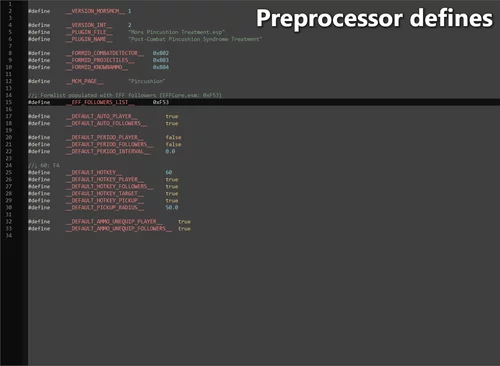
View File Papyrus Pypline Pipeline for compiling Papyrus scripts, built in Python. Easy to integrate with IDE/Notepad++, or use from command line. Ability to parse C like preprocessor directives. Also provides built-in __LINE__ and __SCRIPT_NAME that you can use in your preprocessor directives, and converts binary literals (0b01011101) to decimal numbers, so you can use binary literals in your Papyrus source scripts. Automatically modifies .pas assembly to replace User/Computer name and Script path. Multithreaded processing (able to utilize your AMD Ass Ripper or whatnot to the max). Flexible configuration, keeps your project's Papyrus sources and dependencies separate from the game. Colorful console output (designed, tested, and approved by real circus clowns!). Ability to resize and move the console window to desired position, and change font, overriding OS defaults on the fly. Requires Python 3, and Papyrus Compiler from Bethesda (comes with CK). Not sure about exact Python version - i am using 3.13.1, and i think it may even work with 3.8 or 3.9, but you'll have to try and see what happens. If in doubt, use 3.13.1 or newer. Usage First, set it up using the information in Install Instructions tab above. Then you can run it to process a single specific script in your project: _compile.py "d:/your skyrim project folder/the script.psc" [options] or to process all scripts in a folder: _compile.py "d:/your skyrim project folder" [options] with the [options] being any/none of the following strings separated by white space: d, or dbg, or debug to process the scripts for "debug" and automatically define "DEBUG" variable you can use in preprocessor defines. Otherwise the scripts are processed for "release", which automatically defines "NODEBUG" variable, and instructs the compiler to use optimizations. Depending on your preprocessor defines and conditions that use "DEBUG" or "NODEBUG" variables, it can modify the processed scripts by adding/removing debug traces, lines or blocks of code, etc. p, or prep, or preprocess to run only preprocessing, without compiling to .pas or assembling the scripts into .pex. Can be useful when you want to recompile a single script that depends on other scripts in your project - running this at least once, ensures that all the other scripts in your project get preprocessed and can be found and understood by the Papyrus Compiler, and after that you can keep compiling single scripts one by one or as you make changes without having to run this again (when compiling all scripts in a folder, this is automatically run first for all of them anyway, so for that you don't need it). This can be of course run from your IDE/Notepad++ (how to set it up for NP++ is described on the Install Instructions tab). Optional: You may also want the additional download file below with Papyrus Includes. It contains "dummy-fied" versions of various source scripts - SL, SLP+, DD, DD NG, what have you, including Skyrim itself. These source scripts do not contain actual code, only function signatures and variable declarations. Their purpose is to use them as dependencies when compiling your projects, and they help in two ways: Since there is no actual code the compiler/assembler would need to wade through, your scripts will compile slightly faster. Since there is no actual code, it may decrease the number of dependencies you would otherwise need, and your scripts will compile faster. (if a code, that would require some dependency, is not there now, then you won't need that dependency => less to do for the compiler) As long as you are not compiling these scripts (which you aren't doing, why would you), you don't need them to contain any actual code - only function signatures and variable declarations are what a compiler needs from dependencies to compile your scripts. Obviously, DO NOT mix these with any actual real source files! (eg.: for the love of Todd, don't compile them to put them in your Game's Data/scripts folder!) Dummyfied Papyrus Includes 2025-11-12-0514.7z Submitter Roggvir Submitted 11/12/2025 Category Regular Mods Requirements Python 3 (maybe 3.9, tested on 3.13.1+) Papyrus Compiler for Skyrim from Bethesda (comes with the Creation Kit i think?) Regular Edition Compatible Yes Install Instructions Unpack the archive into a project folder, setup NP++ shortcuts, and do not forget the actual Configuration (see below). (the pipeline is intended to live inside your project folder, so you can customize it per project if need be. You can put it just about anywhere, but i am not covering that kind of setup here, so you will have to figure that out yourself). The folder structure should look like this: My Project │ ├── PapyrusPypline │ ├── preprocessor │ │ └── preprocessor.py │ ├── __init__.py │ ├── assemble.py │ ├── ... │ └── preprocess.py │ ├── _common.inc ├── _compile.py ├── _project.inc └── your project's Source Scripts Then setup Notepad++ shortcuts to run the _compile.py with current folder (for mass compile of all scripts) or current file (to compile the script on active tab). You do that by editing the "C:\Program Files\Notepad++\shortcuts.xml" (your path may be different, maybe you have it somewhere in your User folder). The relevant part of shortcuts XML should looks like this: (the shortcuts are set to Ctrl+F5/F6 and Shift+Ctrl+F5/F6 - you can change them later in the Shortcut Mapper): <UserDefinedCommands> ... <Command name="Papyrus RELEASE" Ctrl="yes" Alt="no" Shift="yes" Key="116">"$(CURRENT_DIRECTORY)\_compile.py" "$(FULL_CURRENT_PATH)"</Command> <Command name="Papyrus DEBUG" Ctrl="yes" Alt="no" Shift="no" Key="116">"$(CURRENT_DIRECTORY)\_compile.py" "$(FULL_CURRENT_PATH)" debug</Command> <Command name="Payprus Recompile All DEBUG" Ctrl="yes" Alt="no" Shift="no" Key="117">"$(CURRENT_DIRECTORY)\_compile.py" "$(CURRENT_DIRECTORY)" debug</Command> <Command name="Papyrus Recompile All RELEASE" Ctrl="yes" Alt="no" Shift="yes" Key="117">"$(CURRENT_DIRECTORY)\_compile.py" "$(CURRENT_DIRECTORY)" release</Command> <Command name="Papyrus Preprocess All DEBUG" Ctrl="yes" Alt="no" Shift="no" Key="118">"$(CURRENT_DIRECTORY)\_compile.py" "$(CURRENT_DIRECTORY)" preprocess debug</Command> <Command name="Papyrus Preprocess All RELEASE" Ctrl="yes" Alt="no" Shift="yes" Key="118">"$(CURRENT_DIRECTORY)\_compile.py" "$(CURRENT_DIRECTORY)" preprocess release</Command> ... </UserDefinedCommands> As mentioned, the above structure is just a suggestion, based on how i like it. You can pretty much set it up any way you want. Configuration All the paths and parameters are set inside the _compile.py, which is the main reason why to keep it inside a project folder, so it can be customized per project. .
-
Version 1.1.0
161 downloads
Pipeline for compiling Papyrus scripts, built in Python. Easy to integrate with IDE/Notepad++, or use from command line. Ability to parse C like preprocessor directives. Also provides built-in __LINE__ and __SCRIPT_NAME that you can use in your preprocessor directives, and converts binary literals (0b01011101) to decimal numbers, so you can use binary literals in your Papyrus source scripts. Automatically modifies .pas assembly to replace User/Computer name and Script path. Multithreaded processing (able to utilize your AMD Ass Ripper or whatnot to the max). Flexible configuration, keeps your project's Papyrus sources and dependencies separate from the game. Colorful console output (designed, tested, and approved by real circus clowns!). Ability to resize and move the console window to desired position, and change font, overriding OS defaults on the fly. Requires Python 3, and Papyrus Compiler from Bethesda (comes with CK). Not sure about exact Python version - i am using 3.13.1, and i think it may even work with 3.8 or 3.9, but you'll have to try and see what happens. If in doubt, use 3.13.1 or newer. Usage First, set it up using the information in Install Instructions tab above. Then you can run it to process a single specific script in your project: _compile.py "d:/your skyrim project folder/the script.psc" [options] or to process all scripts in a folder: _compile.py "d:/your skyrim project folder" [options] with the [options] being any/none of the following strings separated by white space: d, or dbg, or debug to process the scripts for "debug" and automatically define "DEBUG" variable you can use in preprocessor defines. Otherwise the scripts are processed for "release", which automatically defines "NODEBUG" variable, and instructs the compiler to use optimizations. Depending on your preprocessor defines and conditions that use "DEBUG" or "NODEBUG" variables, it can modify the processed scripts by adding/removing debug traces, lines or blocks of code, etc. p, or prep, or preprocess to run only preprocessing, without compiling to .pas or assembling the scripts into .pex. Can be useful when you want to recompile a single script that depends on other scripts in your project - running this at least once, ensures that all the other scripts in your project get preprocessed and can be found and understood by the Papyrus Compiler, and after that you can keep compiling single scripts one by one or as you make changes without having to run this again (when compiling all scripts in a folder, this is automatically run first for all of them anyway, so for that you don't need it). This can be of course run from your IDE/Notepad++ (how to set it up for NP++ is described on the Install Instructions tab). Optional: You may also want the additional download file below with Papyrus Includes. It contains "dummy-fied" versions of various source scripts - SL, SLP+, DD, DD NG, what have you, including Skyrim itself. These source scripts do not contain actual code, only function signatures and variable declarations. Their purpose is to use them as dependencies when compiling your projects, and they help in two ways: Since there is no actual code the compiler/assembler would need to wade through, your scripts will compile slightly faster. Since there is no actual code, it may decrease the number of dependencies you would otherwise need, and your scripts will compile faster. (if a code, that would require some dependency, is not there now, then you won't need that dependency => less to do for the compiler) As long as you are not compiling these scripts (which you aren't doing, why would you), you don't need them to contain any actual code - only function signatures and variable declarations are what a compiler needs from dependencies to compile your scripts. Obviously, DO NOT mix these with any actual real source files! (eg.: for the love of Todd, don't compile them to put them in your Game's Data/scripts folder!) Dummyfied Papyrus Includes 2025-11-12-0514.7z -
Devious Carriages Redux
Roggvir replied to krzp's topic in Downloads - Skyrim: Special Edition Adult Mods
Question: Is all/most of the script sources a result of decompiling PEX files? or is the structure and formatting "as intended"? I am making a small modification, adding MCM toggle to ignore followers when it comes to adding restraints, and the formatting almost hurts my eyes I am tempted to reformat everything, but if the current state is as intended, or maybe to keep it as it was to allow for easier comparison with the old original sources, then i guess i'll leave it be.