
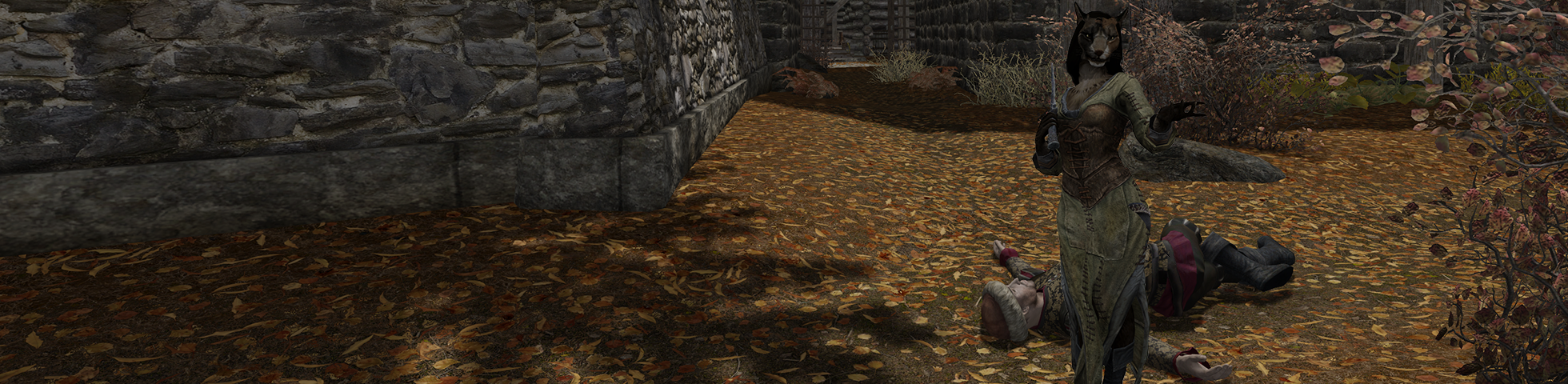
Sloan's Story part 55 - A Search Begins
Entry posted by jfraser in Sloan's story
338 views
By the third week, the sanctuary had learned how to breathe around Sloan.
Not with her -- never that --but around her, the way a body adjusts to a foreign object lodged beneath the skin. The tension no longer spiked when she entered a room. Conversations didn’t halt outright, only softened, reshaped. People stopped watching her hands quite so openly.
Her early assignments had been small and deliberately unglamorous -- deliveries that weren’t meant to arrive late; a drunk mercenary who needed to fall off a bridge in the rain; a courier whose satchel had to be retrieved without anyone realizing it had ever gone missing. Work that tested patience, observation, and restraint.
In a lot of ways, her new “family,” as they liked to call themselves, were a lot like the old.
Naza took the most visible interest in Sloan’s progress; she handed out most of the assignments and ran the debriefings after the missions. She was this timeline’s version of Mishi (especially since Mishi was dead. Which made Sloan wonder if Naza had been this way before Mishi’s death or whether Naza was literally replacing her dead compatriot). Her style was different than the constant belittling and accusations of incompetence Mishi had used – Naza phrased her questions as idle curiosity while her sharp eyes catalogued every answer.
The Nord, Tusef, was the new Jorg (which made her wonder where the actual Jorg was. Maybe he had died too?) He challenged Sloan in fight training, blunt-force spars meant to exhaust rather than instruct. He hit hard and without apology, as though daring her to break so he could justify his initial assessment. Sloan relished the training – thanks to the time travel back to her orphan body, her skills and physical abilities were still a far cry from their peaks. Her training with him always led to good honest physical exhaustion.
Then there was Gilna, who was this timeline’s version of Gilna and who was still conspicuously absent.
What Sloan didn’t remember from last time was the inclusion of not one, but two Argonians. She had had only limited dealing with them before because they were so rare in Skyrim, so to find two in the same group was a surprise.
Veezara watched everything and said almost nothing. When he did speak, it was usually after Sloan had already noticed whatever flaw or pattern the Argonian was about to comment on. It unsettled her more than open scrutiny would have.
Lexzal, on the other hand, treated her with a measured, distant respect after their first exchange. He didn’t test her -- he evaluated her, occasionally offering corrections in passing, always phrased as observations rather than commands.
“You step too heavily when you are thinking,” for instance. “Predators must be mindful of their every step.”
She adjusted.
The other Redguard, Babette, was friendly in a way that never let Sloan forget it was a choice. She asked questions that seemed harmless until Sloan realized they were triangulating information from angles she hadn’t considered. Where had she learned to move like that? Who had taught her to read rooms? What had she done before she’d come looking for the Brotherhood?
Sloan answered carefully with truth, but never all of it. Not that they would have believed all of it, of course.
By the time Kira summoned her (and, to Sloan’s brief surprised, Lexzal), the routine had settled into something dangerously close to comfort. The request itself was strange enough to snap that illusion cleanly in half.
“You’re going north,” Kira said, standing over a table strewn with maps.
Sloan felt the shift immediately--not fear, but attention. This wasn’t a test disguised as busywork -- this was something else.
She and Lexzal stood a few paces apart, close enough to read one another’s posture, far enough to avoid suggesting familiarity. Lexzal’s hands were folded behind his back, his gaze already on the map.
“Purpose?” he asked.
“A problem,” Kira replied. “Or the absence of one.” She traced a finger along a route etched into the parchment. “River Run Road first. If there’s no sign, continue along Pale Rise toward Dawnstar.”
“So we’re looking for a traveler,” Sloan said, more statement than question.
Kira’s mouth twitched. “A brother. Late.”
“How late?” Lexzal asked.
“Long enough to be inconvenient.”
Sloan leaned closer to the table, studying the terrain. The route south from Dawnstar wasn’t forgiving, especially for someone traveling alone--or trying not to be noticed. “He disembarked in Dawnstar?”
“From Cyrodiil,” Kira confirmed. “Ship was logged. Cargo accounted for. Passenger disembarked.”
“And after that?” Lexzal asked.
“That’s what you are going to find out. He should have been here days ago.”
That settled uneasily in Sloan’s chest. The Brotherhood did not misplace its own without consequence.
Lexzal was quiet for a moment, considering. “Possibilities?”
“Several,” Kira said. “None of them tidy.”
Sloan straightened. “Description?”
Kira lifted her gaze from the map, expression unreadable. “Oh, believe me -- you’ll know if you find him.”
That was not helpful.
“His name is Cicero,” Kira added, as if it had only just occurred to her to mention it. “He…stands out.”
Sloan paused, then nodded once. Lexzal’s eyes flicked briefly toward her--acknowledgment, not commentary--and they left together.
Whatever they were walking into, it wasn’t meant to be subtle.
They left before dawn and did not hurry.
The road carried them north through thin light and colder air, the first day passing with little more than the sound of boots on frost‑stiffened dirt. They spoke rarely, and when they did, it was practical. By the third day, the rhythm of travel had settled. They broke when terrain demanded it, not when the sun did.
The dark posed no obstacle to Sloan, only nuance. She noted animal tracks veering off the road, the faint disturbance of brush where something had crossed hours earlier. Lexzal noticed different things: the condition of the road, the age of the frost, the places where carts slowed or stopped without obvious reason. They pointed out what they observed, sometime debating whether it might have anything to do with their quarry, each time coming to the agreement it likely did not.
They had been walking for most of the afternoon when Lexzal broke their mutual silence.
“Do you always leave before dawn or is that for me?”
Sloan didn’t look over. “It keeps people from asking questions.”
“That answers both possibilities.”
She allowed a small breath of amusement. It wasn’t quite a smile. “You don’t ask many questions yourself.”
“I ask the ones that survive consideration.”
“And the rest?”
“Were never worth the answers.”
They walked in silence for a time. Wind moved through the grass at the roadside, bending it all one direction. Sloan adjusted her pace without thinking; Lexzal matched it a step later.
“You don’t carry much,” he said.
“I don’t like to be slowed.”
“By weight?”
“By choices.”
That earned a glance from him--brief, measuring. “You learned that early.”
“Earlier than I wanted.”
He nodded, accepting the limit she’d drawn.
After a while, Sloan said, “You’ve done this kind of work before.”
Lexzal’s staff tapped once against a stone. “I’ve enforced rules. I’ve written them. I’ve broken them when they stopped serving their purpose.”
“And when they did?”
“I enforced them harder than anyone else.”
She considered that. “What changed?”
“The realization that the law rarely belongs to the people who suffer under it.”
“That sounds like regret.”
“It sounds like arithmetic. Regret implies I would choose differently now.”
“And would you?”
Lexzal did not answer immediately. When he did, it was careful. “I choose differently now. That is not the same thing.”
They crested a low rise. The road ahead curved out of sight, bordered by scrub and stone. Sloan slowed, then resumed her pace once she’d confirmed there was nothing waiting.
“You were something official,” she said.
“Yes.”
“Not here.”
“No.”
“Did you leave or were you removed?”
His expression did not change, but his voice cooled by a fraction. “Both.”
She let that stand.
A mile later, he said, “You don’t speak like someone raised gently.”
“No.”
“Nor like someone raised cruelly.”
“Neglect is cruelty in its own way.”
“Fair enough.”
She glanced at him then. “You don’t talk like a killer.”
“I don’t kill because I enjoy it.”
“Neither do I.”
That was the closest they came to agreement.
The light shifted as afternoon leaned toward evening. Lexzal stopped once to study a marker stone at the side of the road, tracing a finger over an old sigil before moving on without comment.
“You read those,” Sloan said.
“I used to have to.”
“And now?”
“Now I prefer knowing where other people think boundaries are.”
“Why?”
“So I know when I’ve crossed them.”
She considered that, then, surprising herself, blurted, “I don’t remember my parents.”
Lexzal looked at her, surprised enough to show even on his lizard face.
“I remember places,” she continued. “Floors. Sounds. How people breathe when they’re lying.”
“Do you miss them?”
“I don’t know who they were. I thought I did, for a time. Now I miss not having to wonder.”
He inclined his head. “That is…reasonable.”
They made camp as the light faded, small and unobtrusive. Lexzal prepared the fire with practiced efficiency, never wasting motion. Sloan watched his hands, the precision.
“You were trained,” she said.
“Yes.”
“Formally.”
“Yes.”
“Not here.”
“No.”
She passed him a strip of dried meat. He accepted it, nodding once.
“You don’t talk about your past,” he said.
“You don’t talk about yours.”
“True.”
“Does that bother you?”
“How could it when I do the same? It suggests survival.”
The fire cracked softly. Night settled in around them.
After a while, Lexzal said, “If we find him tomorrow--this Cicero--what do you expect?”
Sloan stared into the fire. “Noise.”
“Yes.”
“Disruption.”
“Also yes.”
“And underneath?”
She met his gaze. “Something intact.”
Lexzal considered that. Then, quietly, “You’re not wrong.”
They fell silent again, the conversation finished not because there was nothing left to say, but because neither of them was ready to say more.
The road would give them time.
And time, they both knew, was dangerous.
Edited by jfraser
3 Comments
Recommended Comments